Everything you would be asked to produce, in one place.
The Standards for RTOs 2025 expect continuous self-assurance, not a scramble before a visit. The cockpit organises the evidence you already hold, shows where it is strong, and ranks where it is thin.
It counts only what the platform can see. It is not a compliance rating and it never becomes one. The judgement stays with you.
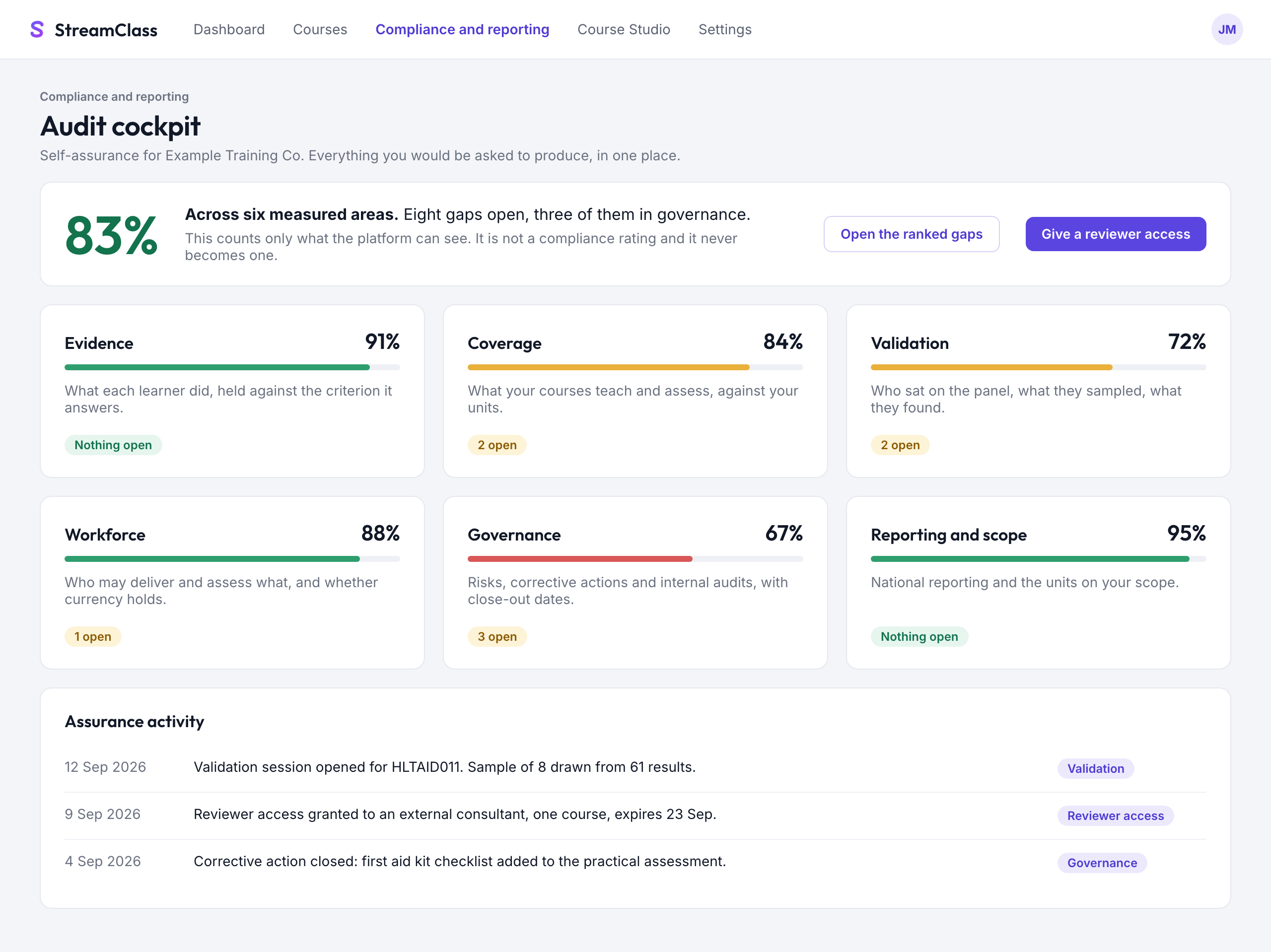
The audit cockpit. Six measured areas, each with its open gaps.
Seven areas, one readiness picture
Each area shows a score for what can be measured and a ranked list of open gaps. Open a gap and it takes you to the record that needs attention.
| Area | What it holds |
|---|---|
| Evidence | What each learner did, held against the criterion it answers, with the record of when it was captured. |
| Coverage | What your courses teach and assess, against the units you are registered to deliver. |
| Validation | Validation on a schedule: who sat on the panel, what they sampled, and what they found. |
| Workforce | Who is approved to deliver and assess what, and whether their currency still holds. |
| Governance | Risks, corrective actions and internal audits, each with the date it was closed out. |
| Reporting and scope | National reporting and the units on your scope of registration. |
| Reviewer access | Scoped, time-boxed, logged access for an auditor, validator or consultant. |
Validation you can show
- A panel, with who sat on it
- A sample drawn when the session opens, with the seed shown so it can be reproduced
- Each record reviewed against the four rules of evidence
- Findings, actions and a validation record you can export
A trainer and assessor register that holds up
- Practitioners, including contract trainers who never sign in
- Credentials, each with the evidence that it was sighted
- A unit capability rests on its evidence and lapses with it, not on a date someone typed
- Standing is asked as at the assessment date, not as at today
Send your auditor, validator or consultant one link
They enter a one-time code and read one screen, criterion by criterion: the assessment first, the teaching as context. The reviewer sees who accepted each result, and their standing on that date.
- Scoped. One course, one cohort or one sample. Nothing else is reachable.
- Time-boxed. Access ends on the date you set, or the moment you revoke it.
- Logged. Every record a reviewer opens is written to a trail you can show.
- Private. Learner identities are coded, and the Unique Student Identifier never appears.
- Sealed. Evidence records are sealed when written, so a later edit shows.
See it against your own scope.
The audit cockpit and reviewer access are part of RTO Assurance.