Your Zoom call, with a room that takes part.
Connect your Zoom account once. From then on your events and quick calls run inside StreamClass: the call in the middle, 45 moments you can send to every screen beside it, and an on-demand version drafted for you when you finish.
Nothing new for your attendees to install. They join from a link, in their browser.
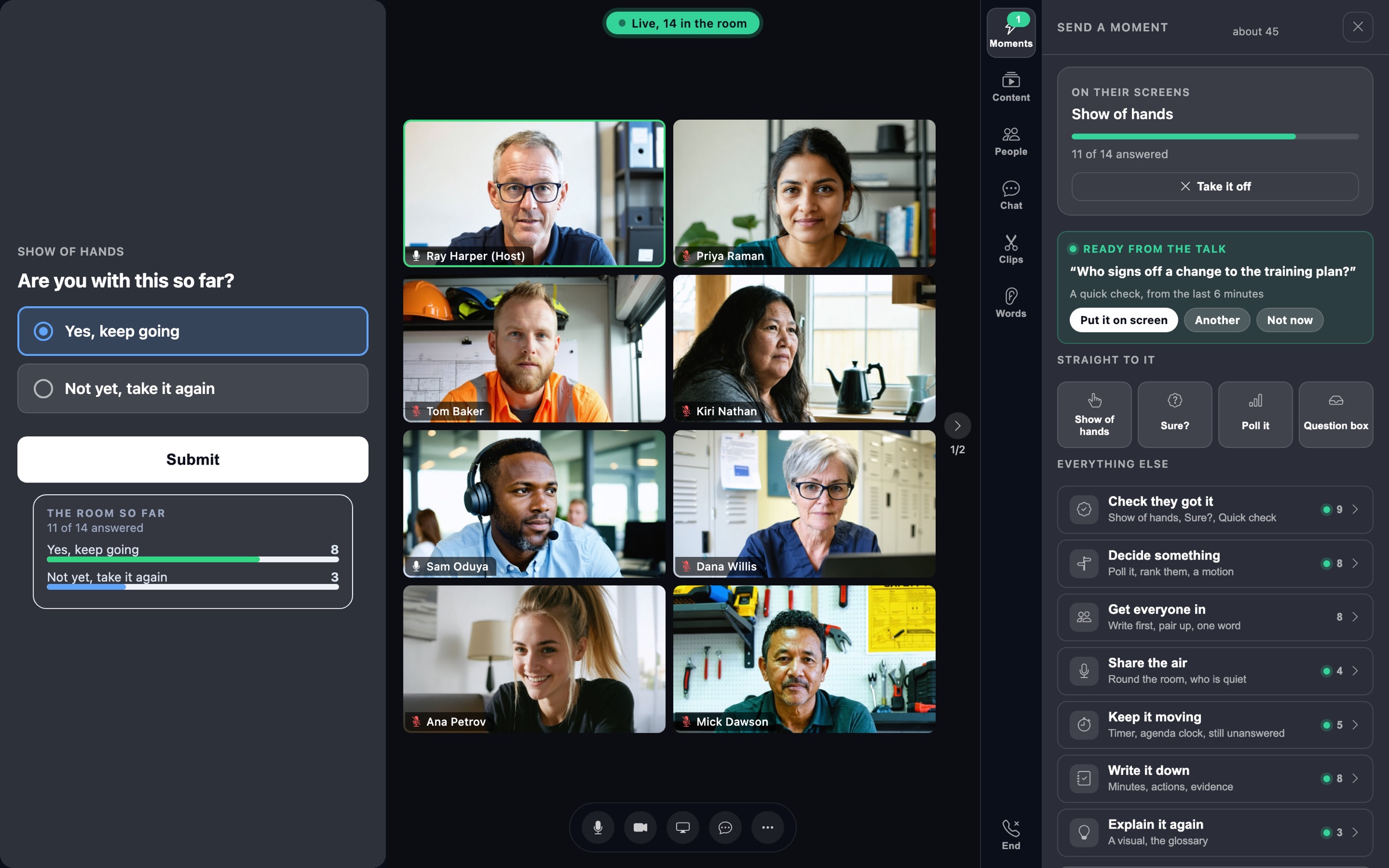
The host's view. The call is your Zoom meeting. Everything around it is StreamClass.
Connect once. It takes about a minute.
Press Connect Zoom and approve on Zoom's own screen. StreamClass then checks two things and tells you plainly what it found: whether this connection can host calls, and whether your recordings can come across.
A Zoom connection belongs to the person who made it. Each of your hosts connects their own, and nobody hosts on anyone else's account. Disconnect whenever you like, and your Zoom details are erased when you do.
What the Zoom page tells you afterwards
| HostingSchedule events and open quick calls as yourself. | On |
| RecordingsCloud recordings come across on their own after each call. | On |
Plan it for a date, or open a room now
Both are the same call once you are in it, with the same moments and the same replay afterwards.
Scheduled events
For the session people put in their diary. Set the date, invite people, and build the line-up of what you will show before anyone arrives.
- One-off sessions or a weekly series, where each week can end differently
- Invitations and a guest list for each session
- Decide ahead of time how it ends and whether it becomes a replay
- Attendance kept with the session
Quick calls
For the call you need in the next minute. Name it, answer two questions, open the room: is it recorded, and what does everyone land on when it ends.
- One link to share. Guests join in their browser, no account needed
- Anything you queued earlier is there to show
- Your earlier calls, and what became of each, in one tab
- Skipping the questions still opens the room straight away
Moments: things you send to every screen
Some are one tap. Others are drafted from what has just been said, so a quick check asks about the thing you explained two minutes ago. You always see a moment just for you before the room does, and you take it off when you are done.
Check they got it9
- Show of hands
- One tap from everyone: with this so far?
- Feedback pulse
- How is this landing so far?
- Quick check
- Drafted from what was just said.
- Explain it back
- One sentence each, checked against the talk.
- Muddiest point
- The least clear thing so far, anonymously.
- Fist to five
- Nought to five: how far are they with this?
- Sure?
- The answer and how sure they are. Shows who is sure and wrong.
- Spot the fake
- A few statements, one of them wrong. Who falls for it?
- Predict, then reveal
- They commit to a guess before the answer is shown.
Decide something8
- Poll it
- The options the room has been circling.
- Rank them
- The order the room can live with.
- Most and least
- Forces a trade-off, not a tick-everything.
- Any objections?
- Sixty seconds, anonymous, before you lock it.
- Motion and vote
- Mover, seconder, for, against, abstain, on the record.
- Decision receipt
- The decision just made, confirmed by the room.
- Spend your dots
- Three dots each across your list. The spread decides.
- Put it on the grid
- Impact against effort for each idea. The room places them.
Get everyone in8
- Question box
- Anonymous questions from the room.
- Everyone writes first
- Two quiet minutes of typing first.
- Stand-up round
- Three boxes from everybody in a minute.
- One word
- One word each, ranked by how many said it.
- Pair up
- A partner by name and the same question, on each screen.
- Write, pair, pick
- Write alone, swap with a partner, pick which goes forward.
- Silent brainstorm
- Two anonymous ideas each, then the room dot-votes.
- Hold your work up
- Everyone snaps what is in front of them. You get the wall.
Share the air4
- Who has not spoken
- Least heard first. An invitation, not a statistic.
- Cold call, kindly
- A private twenty second heads-up, and a quiet way to pass.
- Round the room
- Least heard goes first. Each sees only their own place.
- A quiet word
- A note to one screen only.
Write it down8
- Minutes so far
- The recap and actions, drafted mid-call.
- Lock the actions
- Who does what, confirmed by each owner.
- Name the owner
- Actions nobody owns go to the room: I'll take it.
- Prove you are here
- One tap inside ten seconds, stamped and kept.
- Evidence tag
- A skill shown out loud, kept with its time and its unit.
- Chapter markers
- Name each part of the call for the minutes and the replay.
- That reverses last time
- Checks what is said against what the last call decided.
- Before you go
- Three questions at the close, into the wrap.
Explain it again3
- Make that a visual
- The last explanation, as a checklist or table.
- Glossary as you go
- Terms caught as spoken. Define one for every screen.
- They just objected
- The objection as it was said, and three ways to meet it.
Keep it moving5
- Where we are
- Where the call has got to, in a few plain sentences.
- Five minutes on this
- A clock everyone sees. At zero, put it to a vote.
- Agenda clock
- The time left against what is still to show.
- Still unanswered
- Questions from the room that the talk moved past.
- Parking lot
- Park it now, bring it back before the end.
And on the attendee's side, without interrupting you
Catch me up
What I missed, on my screen only.
Say that again, simpler
The last explanation in plainer words, privately.
How is it going?
A private signal to the host on pace.
Chat
With the room. You can lift any message out and answer it for everyone.
Ask: a question about the call, answered from the call
Anyone in the session can ask what was said, what a term meant, or what was decided, and get an answer in a few seconds. It answers only from this session: what was spoken, what was typed, and what the room put on the record.
It works for you too. Ask what the poll said, or which questions from the room are still unanswered. The same Ask then sits beside the on-demand version, so the people who missed the call can question it as well.
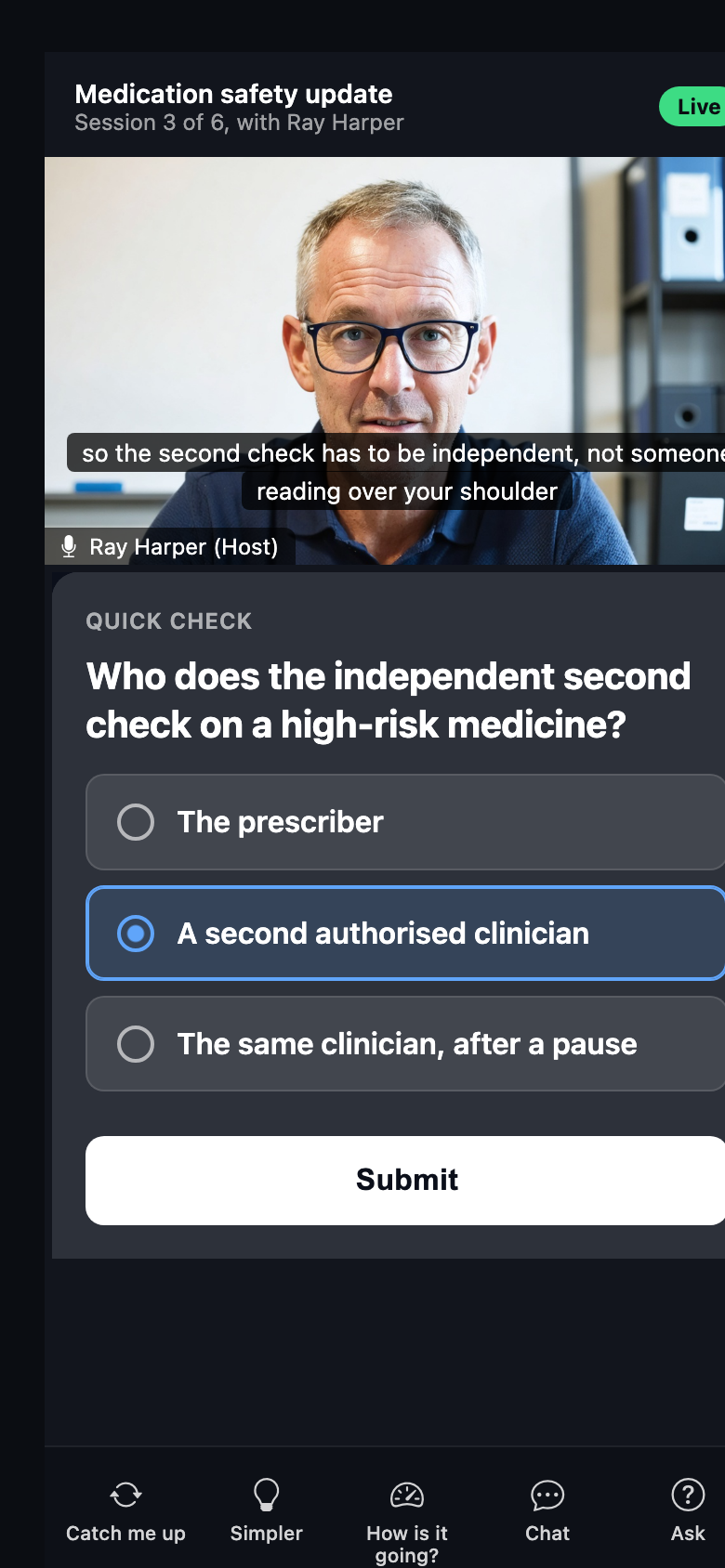
A quick check on an attendee's phone.
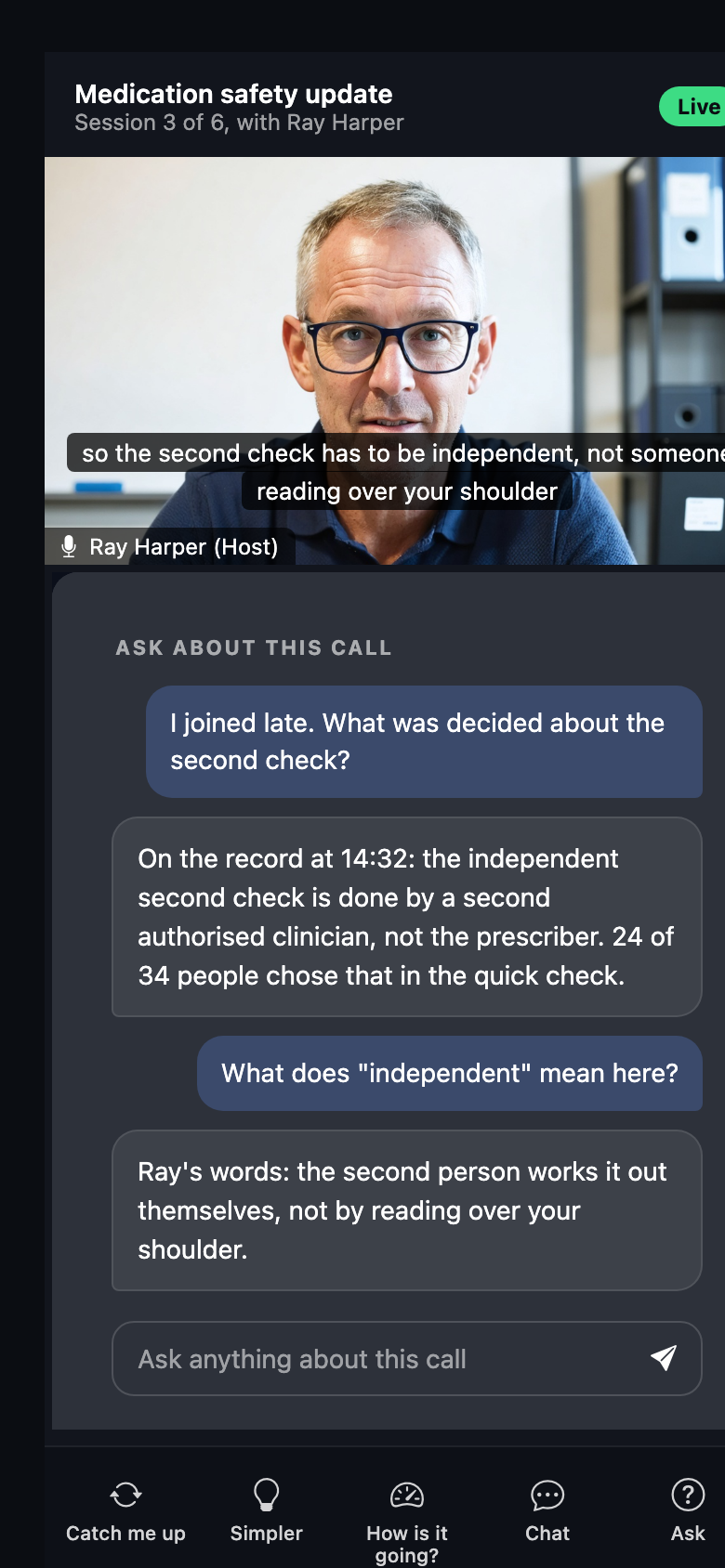
Ask, for someone who joined late.
The rest of what a working session needs
Your line-up, ready before you start
Queue slides, a document, a poll or a form ahead of time, or add one while you talk. Put any of them on every screen with one press.
Captions and a running transcript
What is said is captioned as you go. The transcript is what the drafted moments, the minutes and the replay are built from.
Session debrief
Minutes and actions drafted when the call ends, for everyone who was there.
A catch-up card for late joiners
Someone who joins after the first five minutes gets a short card on what they missed, including what has been decided.
On the record
When the room confirms a decision or locks an action, it is written into the transcript with its time, so the minutes cannot lose it.
Watchwords
Name the words you care about. You get a quiet ping when one comes up.
Chat you can act on
Lift a chat message out of the stream: answer it for everyone, or park it for the end.
Attendance, stamped
Who joined, when, and when they left, kept with the session. Guests join from a link in their browser.
Clips
Mark a moment worth keeping while it is happening, instead of scrubbing for it afterwards.
A call should end on purpose
Pick an ending before you start or as you wrap. When you end the call, every attendee lands on it, and what they answer there is kept with the session.
| Ending | Made for | What everyone lands on |
|---|---|---|
| Quick check | Lectures and training | Three questions drafted from the session. You untick any question before it goes out. |
| Audience wrap | Webinars | Replay by email, one call to action, and the parked questions answered before everyone leaves. |
| Minutes and actions | Team meetings | Everyone agrees the minutes in the room and confirms their own actions. |
| Client wrap | Sales and consulting | What was agreed, the document signed in the call, and the next step booked. |
| Commitments | Coaching | Private commitments, a reflection, and the next session. |
| Announcements | All-hands | The short version, plus an anonymous question box. |
After the call, the on-demand version starts itself
You do not download anything from Zoom or upload anything to us. You can watch each call move along this line from your events page.
Everyone lands on the ending you chose. The room closes.
StreamClass collects the cloud recording from your Zoom account.
The video is prepared and what you showed is placed on the timeline where you showed it.
You look it over, trim it, change anything. Nothing publishes until you say so.
Attendees get Watch it back. Everyone else gets it on demand.
For the people who were invited
The session as it happened, with the moments in place, sent to the people it was for. No sales page, no price, nothing to set up.
For everyone who was not there
The same recording with a page of its own, a price if you want one, a final check and a certificate. You choose which on the launch step, and you can change your mind later.
Before you connect
Which Zoom plan do I need?
A paid Zoom plan with cloud recording, so the recording can come across by itself. Without cloud recording you can still run sessions. There just will not be a replay.
How many people can join, and is it Zoom Webinars?
As many as your Zoom plan allows in a meeting. Sessions run as Zoom meetings, not the separate Zoom Webinars product, whether you call yours a webinar, a class or a meeting. StreamClass does not count or charge for attendees.
Do attendees need Zoom, or a StreamClass account?
No. Guests join from a link in their browser. Members who are signed in join from the event page.
Running an RTO?
A live class can carry attendance proof and evidence tags against a unit. See how it works for RTOs
Run your next session here.
Connect your Zoom, open a quick call with a colleague, send a show of hands, and end it. The replay will be waiting for you.